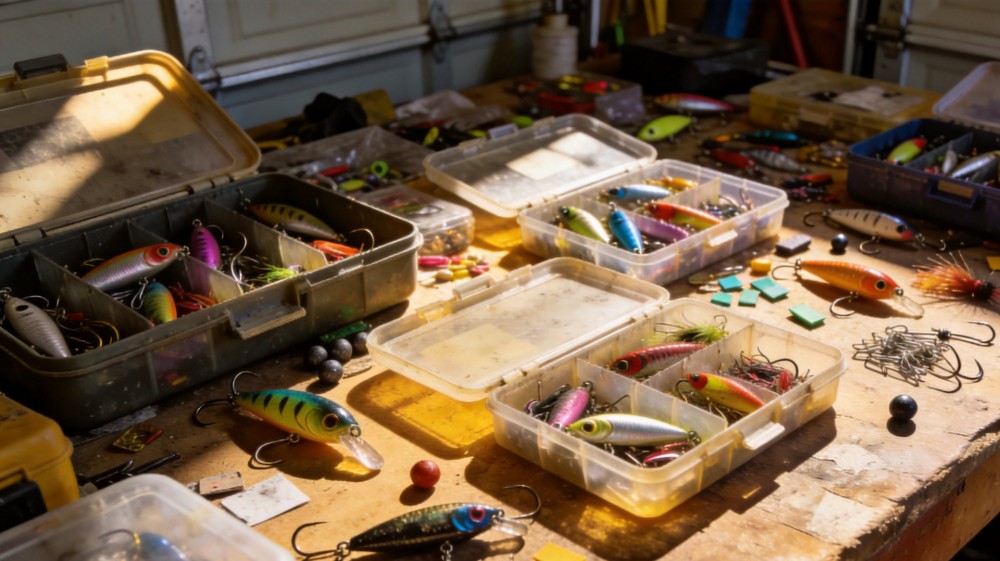
I was fishing a tournament in Alabama once — October, perfect clear water, sun on my back, boat idling right over a school of thick bass holding near a submerged timber pile. The fish were thick enough that I could see them sitting on top of the wood at six feet deep through perfectly clear water. Perfect spot. Everything should’ve worked.
So I threw a bluegill crankbait. Nothing.
Switched to a white soft plastic worm on a shaky-head rig. One strike from a three-pounder and three seconds later he spit it out. No hook set possible because the hook never fully penetrated — shallow bite, probably because the fish were spooked by my constant switching, maybe because the presentation was boringly standard for pressured bass in October.
Then I switched to a jointed swimbait in chartreuse. That’s when the frustration really hit. Three lures. Twenty minutes. Zero actual hookups. And you know what? My opponent three boats away was working the exact same piece of timber with two lures — a green pumpkin worm and a chartreuse lipless crankbait — and landed four keepers while I stood there swinging the boat around like an idiot searching for whatever magic lure I hadn’t tried yet.
I lost that tournament by thirty-two pounds.
Not because of gear. Not because of skill gap. Because I threw five different lures into the same twenty-square-foot zone of productive water in forty minutes and convinced myself that I just needed “one more thing” that would make it work. What actually made it work for him was sticking with two and knowing exactly how each one behaved in those specific conditions.
This is not a story about me being bad at fishing. It’s a story about something most beginners don’t realize until they’ve wasted dozens of weekends doing exactly what I did: you can catch nothing in a fish-filled lake because you’re moving too fast.
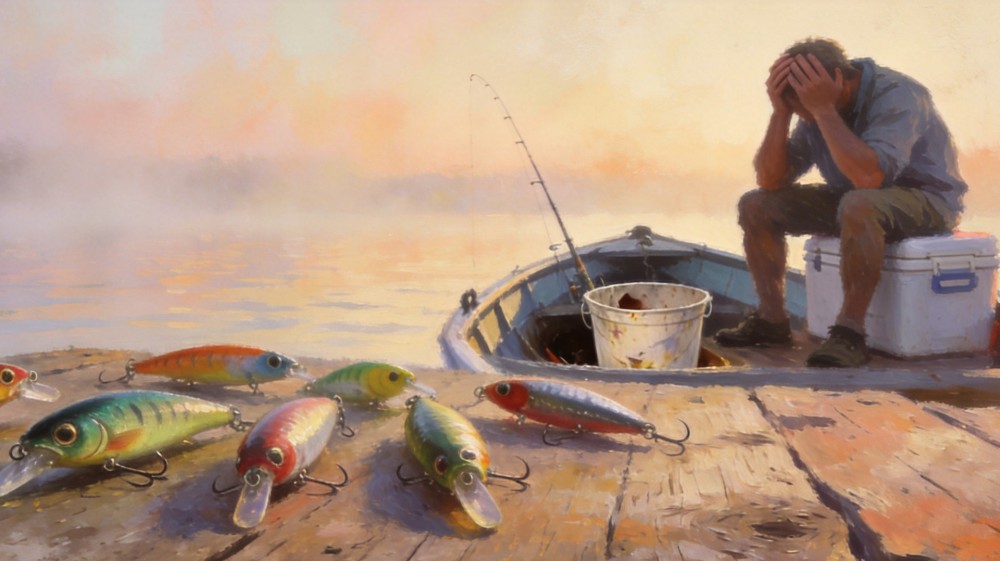
The Twelve-Minute Rule (And Why You Break It)
Here’s something most anglers never hear told to them until years into the sport: fish will investigate and often strike a stationary or slow-moving bait if you leave it alone long enough. The average beginner switches lures after twelve minutes or fewer.
The problem is twofold.
First, a bass typically spends three to five minutes approaching a new bait in unfamiliar water before committing to a strike. If you switch three minutes into the retrieve because “nothing is happening,” you cut off every approaching fish before it even realizes it wants the bait. Twelve minutes gets you roughly one approach window. Two approaches minimum before switching makes sense. Most beginners don’t even make it to one.
Second — and this is far more important — fish learn. Bass are not mindless predators running on instinct alone. They have memory, association, pattern recognition. A bass who gets bit repeatedly in the same structure on a bluegill crankbait that morning becomes highly educated about bluegill crankbaits by early afternoon. If you keep throwing one after another, the bass may refuse a third, but they don’t know about the fourth. Your constant switching keeps their uncertainty high and their confidence low. They keep eating something, but they keep rejecting the bait you’re currently offering because they haven’t decided if that one is food yet.
When you sit on one lure for thirty minutes, or even forty-five — particularly when targeting pressured bass around a single productive structure — you give them time to build confidence. You show repetition. You become predictable in a way that triggers strikes instead of triggering rejection.
I learned this through years of losing on water where a guy three rods ahead of me landed twenty keepers. My theory was always superior tactics, better timing, sharper technique. He told me once after a tournament, “Jone, I only brought three lures today and I threw two of them the entire session.” Two. Out of hundreds of possible combinations. Two for seven hours.
That’s not impressive because he was lazy. It’s impressive because he understood something fundamental about bass behavior and human patience that I was still struggling to grasp: the first lure you throw into a good spot is usually the best one to stick with.
When to Stay Put (And When to Move On)
Let me be very specific about the rules I follow now after sixteen years of North American freshwater fishing, across more states and seasons than I care to count. These are the criteria for deciding whether to stay with the current setup or completely rethink the situation:
Criteria for Staying With a Lure
You see fish. Literally see them. Rollers, tail-walks, any surface activity. Fish seeing your lure and turning away are telling you they know what it is and prefer something else. Staying put means adjusting retrieval speed, pause frequency, depth zone — but switching the lure itself is premature if you have visual confirmation of active fish.
You’re in a temperature transition zone. Remember the thermocline discussion from last week? Bass hold at temperature boundaries. A lure that works well at five feet won’t work at eight feet in the same thirty-minute stretch. But once you find the exact depth where bass are holding at the thermocline, stick to that depth regardless of lure choice. Don’t waste time hunting in wrong depths. Find the right layer. Stay there.
You get one good strike. Any strike — whether hooked or not — tells you fish are interested but not eating hard. Modify presentation slightly: slower retrieve, longer pause, change color if clarity demands it. Do not assume switching to a totally different lure type solves this. Often the fish wanted the bait but needed patience or a small tweak to commit.
Water conditions are stable. Clear sunny morning that stays clear sunny morning? Good. Low wind, low current, stable barometric pressure? Excellent. Any of these combined with an unproductive retrieve of fifteen-plus minutes usually means your location is suboptimal, not that your bait is wrong. Move elsewhere. But do not move your bait while simultaneously abandoning a promising area.
Criteria for Swapping
You’ve been retrieving steadily for thirty minutes with zero interest. No bites, no approach behavior, no visual signs of fish. Thirty minutes is generous. Some days fifteen minutes is sufficient — particularly if you’re covering water aggressively and hitting multiple distinct structures rapidly. But if you’ve given each location at least a quarter-hour of focused effort and nothing reacts, switch tactics entirely. Try a deeper retrieval. Switch from bottom contact to mid-water. Change from erratic cadence to dead-slow movement.
Water changed significantly. High wind kicked up surface chop? Bass are holding shallower or deeper depending on species preference. Rain moved river water from clear to chocolate milk in two hours? Switch to dark-colored lures immediately — visibility dropped from sixty feet to two feet. Fish need high-contrast profiles. Water temperatures jumped eight degrees overnight? They’re feeding differently. Slow down your presentations universally across all baits.
A big bite pattern shift. You were catching consistently on jigs along a steep drop-off and then within ten minutes the pattern shifted entirely to topwater activity on a flat shallow weed bed fifty yards away. This happens constantly in spring and fall when bass move vertically through the water column based on feeding windows. New zone requires new lure. Moving between zones is non-negotiable. Within a zone? Change nothing but retrieve speed.
How to Think About Lure Switching Without Panicking
The hardest thing about switching lures correctly isn’t recognizing when to do it. It’s resisting the urge to switch when you’re tempted not to switch. And vice versa — knowing when staying is actually wrong and you need to move locations entirely.
Most beginner frustration comes from two conflicting instincts: (a) throwing everything in the box hoping something works, or (b) stubbornly sticking with a lure they love because it “worked yesterday” when the conditions clearly changed. Neither approach is sustainable. Here’s how I balance both impulses:
Before every session, decide which three lures you’ll fish with. Write them on a sticky note taped inside your tackle lid. Keep them consistent across all sessions unless water conditions explicitly dictate otherwise. This eliminates the panic of endless options while you’re already on the water trying to figure out what’s going wrong. Three choices reduce decision fatigue during critical fishing moments. You stop thinking “maybe I should try X instead” and start thinking “which of my three prepared options matches this specific situation right now?”
Track the lures that produce results alongside the lures that don’t. By session six or seven, you’ll notice patterns — green pumpkin worms catch in clear water, chartreuse crappie tubes work when wind blows, black/blue creature baits dominate shaded timber areas. These aren’t universal laws. They’re personal data points specific to your local waters and experiences. Write them down somewhere permanent. A small notebook. Your phone. A sticky note. Doesn’t matter. What matters is retaining information instead of reinventing the wheel every Saturday morning.
Practice retrieving without looking at your lure. Close your eyes occasionally as you’re reeling and pay attention exclusively to what your hands feel against the rod tip. Vibrations transmit through the line into your grip before your eyes register anything. The faster you react to vibrations, the more fish you’ll hook before the fish realize they made a mistake. Practice this daily until you can distinguish subtle differences in lure weight, size, and retrieval resistance purely through tactile feedback.
The Tournament Lesson That Changed Everything
That Alabama trip taught me something I didn’t know I needed to learn: competitive pressure amplifies every weakness. Under normal recreational circumstances, a beginner might casually try three or four lures over a full day without consequence — some work, some don’t, everyone goes home satisfied regardless. In a competitive environment, where every cast counts and every minute translates directly to potential prize money or ranking, the cost of experimentation skyrockets.
My opponent who caught four while I stood there frantically cycling through five options wasn’t necessarily a better fisherman. He was more disciplined. He committed to two lures, understood their exact behaviors at different retrieves speeds, knew which depth produced strikes and which produced misses. Discipline beats talent in competitive situations because talent is wasted when you keep changing your approach without evaluating whether the current approach actually has a chance.
After that tournament, I sat in my truck for twenty minutes before heading home and wrote down a simple rule on the dashboard visor with a ballpoint pen: “One good lure for one good duration wins every time.” Not ten different lures each for one minute. Not fifty lures for ten seconds apiece while you convince yourself you’re “trying everything.” One good lure. Thrown repeatedly at the same productive spot. For at least thirty uninterrupted minutes. One time per structure segment. Not forever. Just once, thoroughly, before you accept that it doesn’t work there.
The math is brutal but elegant. Twenty minutes of productive casting at five effective lures per season equals one hundred minutes of pure focus. A typical weekend where you cycle through ten lures in four hours produces perhaps two minutes of truly concentrated effort on any single presentation. One hundred divided by two equals fifty times more opportunity when you stick with it.
Fifty times.
I don’t believe anyone who fishes with anything less than discipline on a regular basis ever maximizes their potential. Period.
One More Thing
This isn’t about fishing exclusively. It’s about learning restraint — not trying everything under heaven when the situation calls for patience and precision. The principles translate directly into business meetings, job applications, dating relationships. Staying present. Observing deeply. Making one solid effort instead of a dozen half-hearted ones scattered across too many directions.
But let’s be honest. You came here because you want to catch fish. So here’s what to do next:
Pick your favorite rod. Load the simplest lure you own — a plain green pumpkin worm on an offset hook. Walk to the nearest body of water. Cast to the closest edge of vegetation or timber or dock piling. Let the lure settle. Wait. Watch. Retrieve slowly. Switch to nothing else for the next half hour. If nothing happens after thirty minutes of deliberate, methodical effort, then try a different angle or location entirely.
But during those thirty minutes — do not second-guess yourself. Do not reach into the tackle box. Do not question whether you chose correctly. Commit fully to whatever you decided before stepping onto the dock. One lure. One direction. One continuous effort.
The water rewards commitment more than experimentation almost every time.
If this post helped, share it with the friend who walks into Academy Sports and buys eight different packages of brightly colored lures that he thinks will somehow magically solve his fishing problems.