You don’t catch fish by finding fish. You catch them by finding where they’re already sitting.
This is the single biggest misconception I hear from beginners. They walk onto a dock or wade into a lake expecting to find fish like looking for lost keys on the floor. They cast in every direction, working lures through every pocket of water. They think they need to discover where fish happen to be.
The truth is more elegant and far more repeatable: fish hold structure. Always have. Always will. Your job isn’t to search randomly — it’s to identify which structures are holding fish and cast where those structures meet water that makes sense.
This sounds abstract until someone hands you a mental map. Let me give you one. After ten years fishing Texas reservoirs, Great Lakes smallmouth, Florida flats, Pacific Northwest steelhead rivers, and Carolina surf breaks, these are the only three water-reading signals I actually use anymore. Everything else is noise.
Signal One: Temperature Transition Zones
Fish don’t wander randomly across a lake. They migrate vertically and horizontally through temperature layers, just like humans move between floors of a building based on whether it’s too hot upstairs or freezing downstairs.
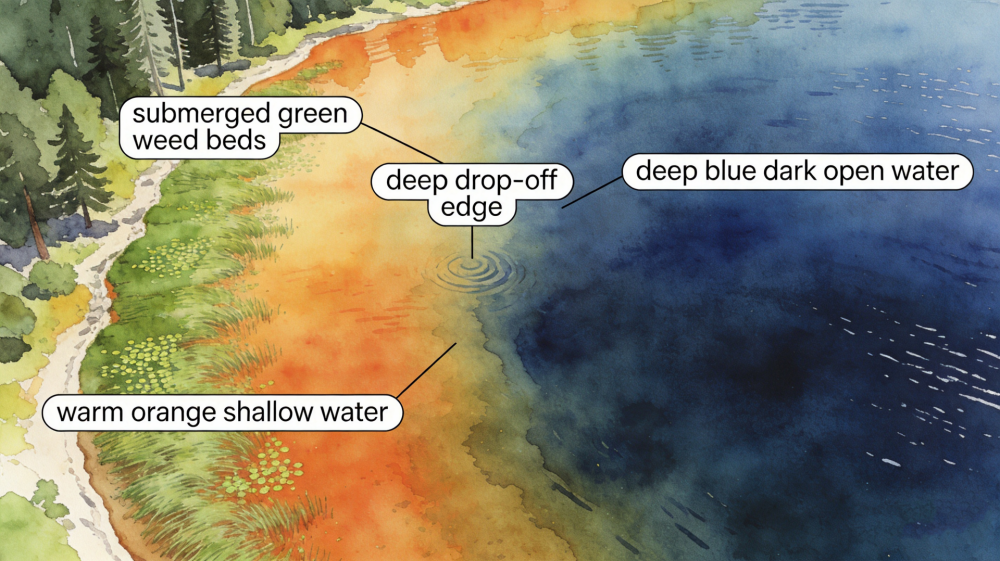
In spring, sun heats the shallow edges first. Bass move up to spawn on shallow shoals where water reaches sixty degrees. But twenty yards offshore, five feet down, the thermocline still holds fifty-five-degree water from winter. Bass won’t cross that temperature wall. They sit either above it or below it, never between.
In summer, the surface warms to seventy-five and the bottom stays at forty-two. Bass cluster at the thermocline — usually twelve to eighteen feet deep depending on clarity. Cast directly offshore past the weed line toward deep water, and work the transition as your lure crosses the depth boundary. That’s where you’ll find them.
In fall, surface cools and fish move back shallow. The thermocline collapses. Suddenly a bass bed that was twenty feet deep is accessible from shore at six feet. I call this the “golden week” — once a year, the same stretch of shoreline that produced nothing for four months becomes productive within days. The fish haven’t moved. Their behavior hasn’t changed. Only the temperature layer shifted.
What this means practically: you learn the depth of each temperature transition in your local lake, and you cast at that transition, not into uniform depths where nothing changes.
Here’s how to read it without expensive equipment:
On the shore, stand where you can see underwater structure. Look for the point where shallows end and deeper open water begins — mud gives way to rocks, then sand, then deeper darkness. That boundary is your temperature wall. Cast parallel along it and let your lure ride across it on every retrieve.
In a boat, deploy a simple thermometer if you have one. Drop it off the front of the boat while moving toward deep water slowly. Watch the numbers drop. When you see fifteen-degree change over two feet — boom, that’s where bass are holding. Work that exact depth.
If you don’t have a thermometer (most people don’t), look for floating weeds or algae lines. These accumulate at temperature boundaries because slower-moving cold water doesn’t mix with faster warmer currents. Fish follow weed lines. Weed lines mark thermoclines. It’s not perfect but it’s enough.
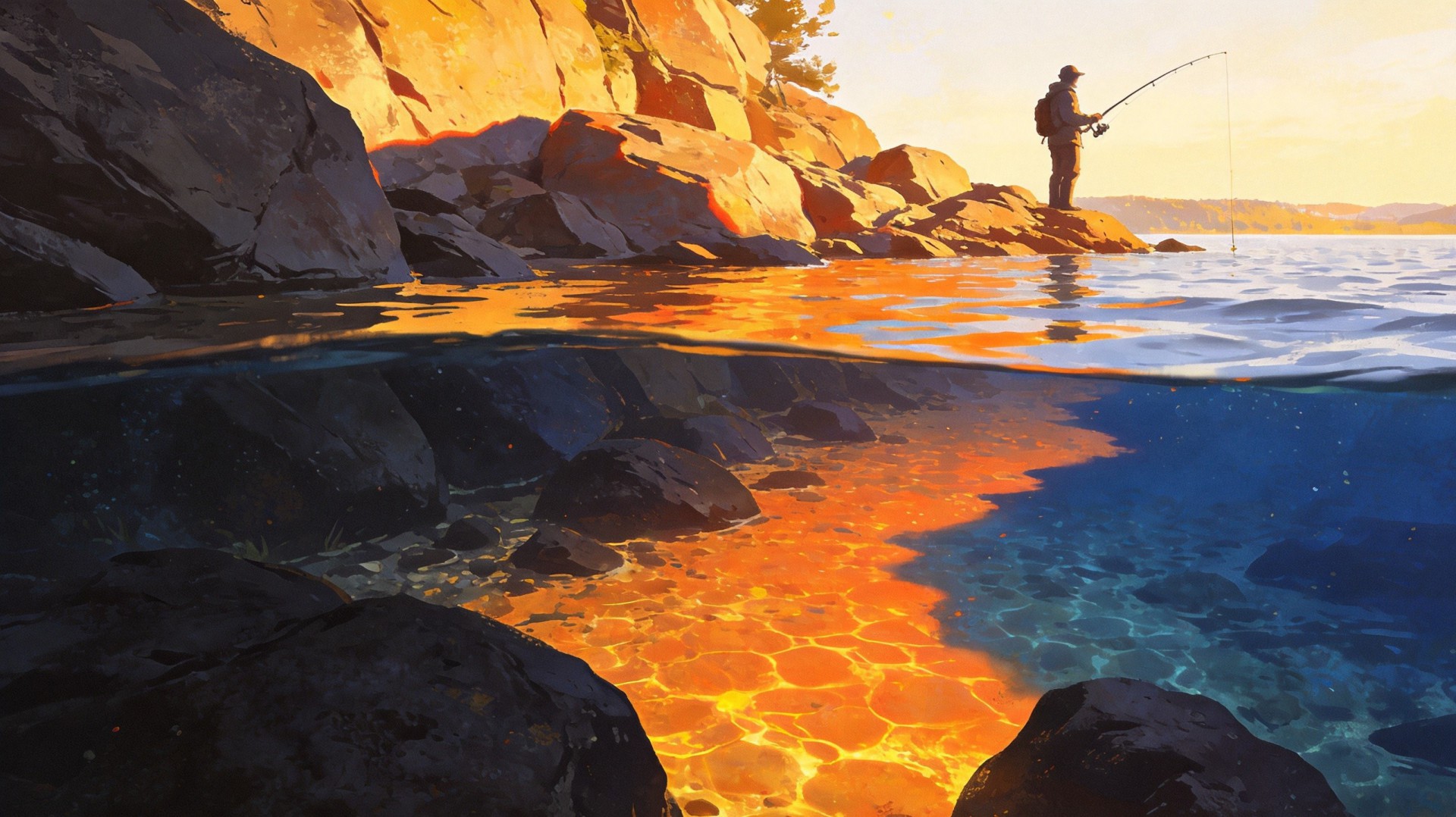
Signal Two: Shallow-to-Deep Transitions with Cover
The second most important reading skill in freshwater bass fishing — the one that separates anglers who consistently catch fish from those who catch occasional ones — is understanding how bass use cover in shallow water.
Think about it from a bass’s perspective. He lives in twenty feet of water under open sky. Every morning, something eats his kids or tries to eat him. He needs protection. The fastest, cheapest way to feel safe? Hang out next to something that blocks line-of-sight attacks — bushes underwater, submerged timber, dense weeds. Anything that breaks the open water geometry and hides him from predators below.
Bass don’t always sit in cover. Sometimes they patrol along the edge of cover — the boundary between weed beds and open water, the outside lip of a brush pile, the transition from vegetation to bare lake bottom. This is the hunting corridor. They position themselves in security and sally out to strike prey.
As a baitcaster, you want your lure crossing that edge at the right angle. Here’s why:
A lure moving parallel along the weed line triggers strikes from curious but non-aggressive fish who aren’t leaving cover. A lure that enters and exits the weed bed rapidly gets hung constantly or scares fish inside the vegetation. The sweet spot is a retrieve that traces the edge cleanly — staying outside by inches, giving the lure maximum exposure, and crossing the boundary only on retrieval speed changes or pauses.
How to actually do this on any unfamiliar lake:
Walk the shoreline before casting. Spend ten minutes just scanning visually from shore. Mark in your head three distinct underwater structure points: a weed bed boundary, a drop-off zone, a submerged log patch. These are your primary targets.
Cast toward the nearest point and retrieve parallel to shore. Let the lure slide along that weed-line or structure-edge. Slow retrieves, long pauses. You’re covering ground along a known transition zone.
When in doubt, go wide, then work back toward shore. If your lure goes too far from cover, slowly reel it inward until it reaches the transition zone. Fish often chase lures moving out toward open water as fleeing baitfish. A slow inbound retrieve triggers this reaction more than anything else.
I learned this from watching old locals on lakes I didn’t yet understand. There was a guy in Georgia named Earl who fished the same cove every Saturday morning and caught five to eight keepers. His secret wasn’t his gear — he used the cheapest rod on the market. His secret was walking the cove shore for twenty minutes identifying three cover-to-deep transitions, then methodically working each one for ninety minutes before moving to the next. Three times. No more. He knew exactly where he was and why.
That’s what I’m teaching you when I say: stand, watch, cast along the edge. Repeat.
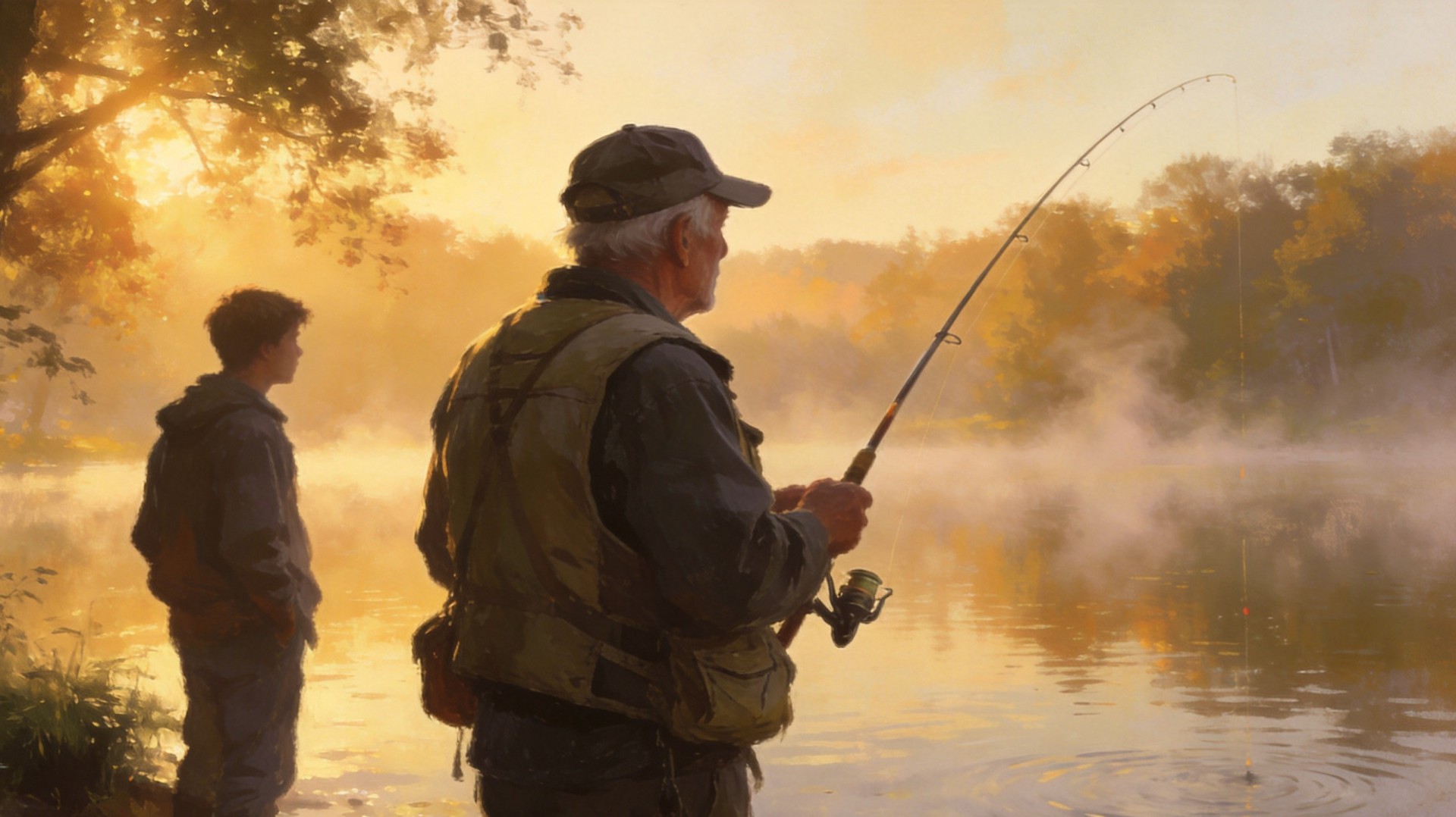
Signal Three: Light Conditions and Fish Positioning
Light is invisible underwater but fish see it, feel it, and respond to it constantly. Understanding basic light physics under water is the difference between casting aimlessly and targeting specific micro-zones.
When sunlight hits water, roughly half reflects off the surface and half penetrates. The penetrating portion scatters at angles — stronger straight ahead and weaker at oblique angles. This creates what fishermen call “shadow lanes.” Under a dock pilings, under overhanging branches, under cloud cover edges — these are all shadow lanes where bass position themselves to ambush fish hiding in darker areas.
In clear water, light penetration goes deeper. You can see thirty feet down on a sunny day. In stained or muddy water — common after heavy rain, especially in Texas and Florida — light only penetrates three to five feet. Bass in stained water position differently because their visual hunting range shrinks dramatically. They rely more on lateral line vibration detection and stay closer to the surface during daytime.
Here’s the practical takeaway — where to cast based on light conditions:
Bright sunny days: Look for deep cover. Bass hide in the shadows of docks, below bridge pilings, around large submerged stumps where light barely reaches. Cast under overhangs — not at them, under them. Let your lure sink past the shadowed area and let it hang stationary there for five seconds. Strike rate doubles compared to fast retrieves here.
Overcast days: Shallow water becomes prime time. Cloud cover diffuses light, creating soft illumination across all depths simultaneously. Bass feel less exposed and move into two-foot-deep weeds feeding on baitfish. This is when my green pumpkin worm catches fish in six feet of water — impossible on bright sun days but highly effective when clouds blanket the sky.
Early morning and late evening: Low-angle sunlight pierces shallow water horizontally rather than vertically. Look for shallow shoals on southern and southwestern exposures where early morning rays hit first. These micro-heating zones attract baitfish which attract bass within minutes. Five minutes after sunrise on a clear day — walk out to a south-facing bank with shallow weed growth, cast parallel to shore, and prepare for strikes.
I remember one late afternoon in Alabama — October, beautiful clear water, light wind on the surface. I stood at a shallow shoal and watched bass rolling baitfish to the surface. Not deep. Not structure. Just a shallow sand-bottom shelf where warm water had collected in the afternoon sun. Three casts. Three strikes. All fish over four pounds. Location mattered absolutely zero percent — timing and light angle mattered one hundred percent.
The Unified Framework: Read, Cast, Adjust
Let me tie all three signals together into a single repeatable process you can apply to any lake, anywhere.
Before every session, I ask myself these questions in order:
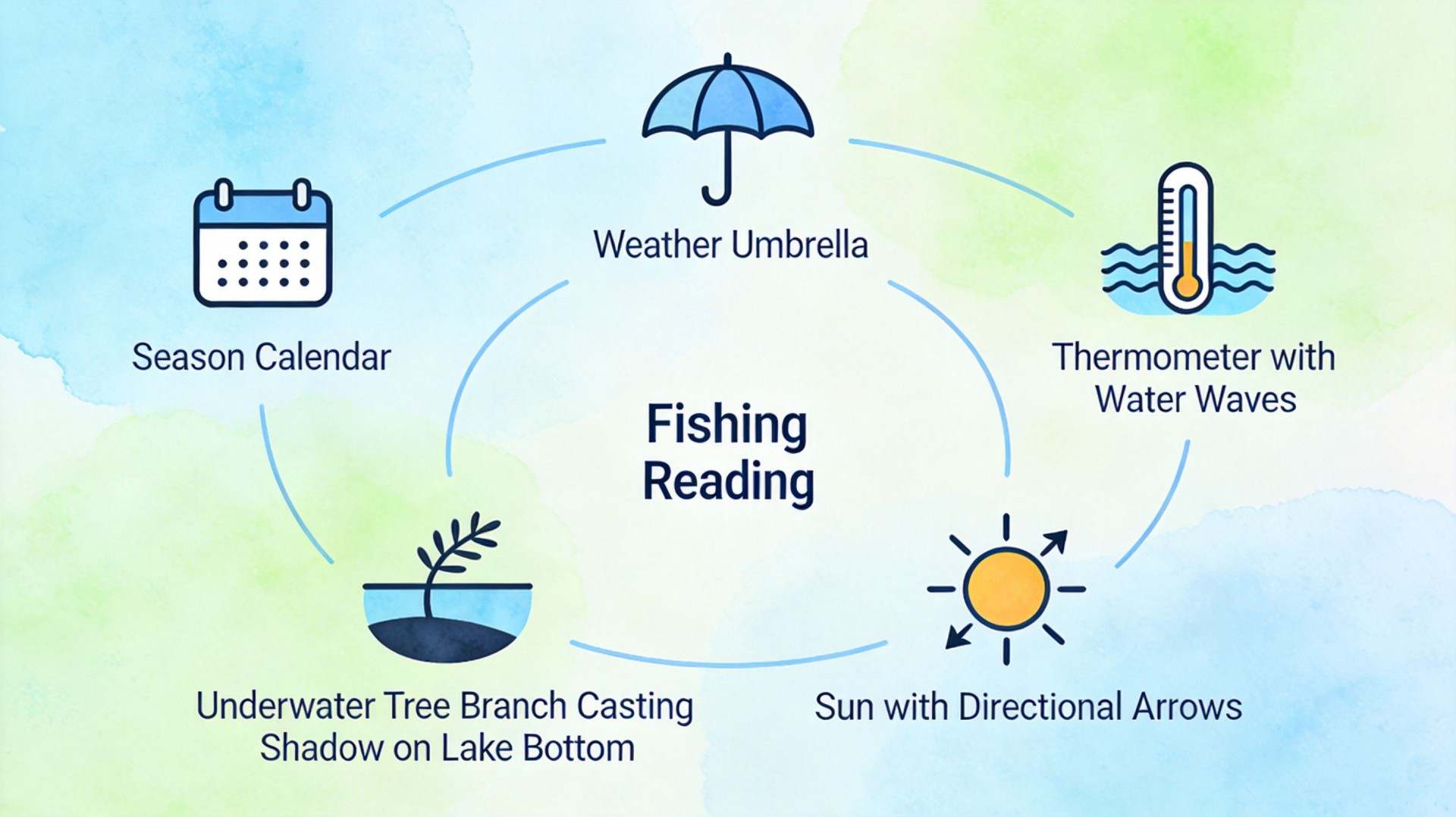
What season is it? This determines baseline depth preference — shallow in fall, deep mid-water in summer, spawning shallows in spring.
What’s the weather doing? Clear/sunny = cast to shadows. Cloudy = fish are available anywhere. Rain/moving water = stained water strategy, short cast distances.
Where does the temperature transition live? Identify deep-water thermocline depth. Cast at that transition depth on every retrieve.
What underwater cover exists nearby? Weed beds, timber, rocks, docks. Find the edge of cover meeting open water. Cast parallel along it.
Where is the sun hitting right now? South-facing shores warm first. East-facing shores get early light. Shadow lanes form on opposite sides of structures. Target the lit zones with adjacent cover.
Five questions. Twenty seconds to mentally answer. Then cast.
If nothing happens after twenty minutes at the same spot recalibrating to these five factors — you’ve identified a bad spot or you’re presenting incorrectly. Moving on. No waste. No frustration. Data-driven decision-making applied to the water.
I run through this checklist at least twice a year now. Every time I step onto unfamiliar water, these five questions guide me to productive spots within the first hour. Some of the most remote, untouched lakes I’ve fished in Montana and British Columbia responded exactly to this framework. Because bass biology doesn’t change based on geography. Their instincts remain the same whether you’re fishing Lake Texoma or the Great Lakes. Only the presentation details vary.
Final Thought: Patience Is the Skill No One Can Take Away
Reading water well takes practice. Not years — weeks. You go to three or four different lakes, observe temperature shifts, note cover-to-depth transitions, and pay attention to where fish actually produce versus where they don’t. Within a month, the patterns become instinctive. You stop thinking “where do I cast?” and start feeling “that looks like a good spot.”
But feeling comes after knowing. And knowing comes from paying attention to what’s actually happening under the water’s surface rather than assuming something arbitrary.
Here’s my last piece of advice on reading water, borrowed from an old Georgia fisherman I fished with for a full autumn season: "If the water doesn’t look interesting from shore, it probably isn’t."
He meant this literally. Water that looks flat and featureless from the bank usually is. But water with texture — ripples pushed by wind across weed beds, shadows cast by overhanging trees, visible temperature gradients between shallow and deep zones — that’s where bass concentrate. Look from shore, identify interesting water, cast specifically at that interesting water. If a second cast to the same location fails, move to the next interesting spot.
Don’t waste your entire morning fishing uninteresting water because it was productive yesterday. Yesterday’s fish aren’t today’s fish. Today’s temperature structure might be completely different from yesterday’s. Read again. Recalibrate. Adjust.
That’s fishing. Not magic, not luck. Just repeated observation and incremental improvement. And after a decade of sitting on waters across this continent, I can tell you this: some of the best lessons I learned came from days when I caught nothing. Those were the days I actually read the water instead of hoping it would read itself.
Summary: Fish don’t wander randomly — they hold structure. After ten years of North American waters, here are three signals that always work: temperature transitions, cover-to-deep boundaries with light conditions. Combine all five into a repeatable pre-cast checklist. You don’t need expensive gear. You need to learn which waters look interesting from shore.
If you found this useful, share it with someone who casts randomly and wonders why they never catch anything. Or if you’re the one doing it — bookmark this page. By trip twenty, you’ll read water like breathing.