August in Texas doesn’t just feel hot. It feels personal.
The kind of heat that makes you question every life choice that led you to own a truck, a boat, and a persistent delusion that you could be a fisherman. The asphalt shimmers off Interstate 35 like a mirage. The lake surface looks like it’s breathing steam. And the bass? They’ve vanished into eighteen feet of dark water, sitting motionless on a log that hasn’t seen sunlight in three weeks, waiting for September to arrive and make the world livable again.
Summer daytime bass fishing in Texas is brutal. The fish are deep, the heat is oppressive, and the bite is often sluggish to nonexistent from June through August. It’s easy to conclude that summer fishing is over and wait until fall.
But the fish aren’t dead. They’re just on a different schedule than you.
Why Night Bass Fishing Exists
Bass are opportunistic predators. They hunt when the conditions favor them, and they rest when the conditions don’t. In Texas summer, daytime conditions favor no one — not the angler, and certainly not the bass.
Here’s the biology: bass are ectothermic. They don’t regulate their own body temperature. They seek water at the temperature where their metabolism works best — roughly sixty-five to seventy-five degrees for largemouth bass. When surface water hits eighty-five, ninety, or (in particularly brutal years) one hundred degrees, bass migrate vertically to find cooler layers. That’s the thermocline — the invisible wall between warm surface water and cold deep water.
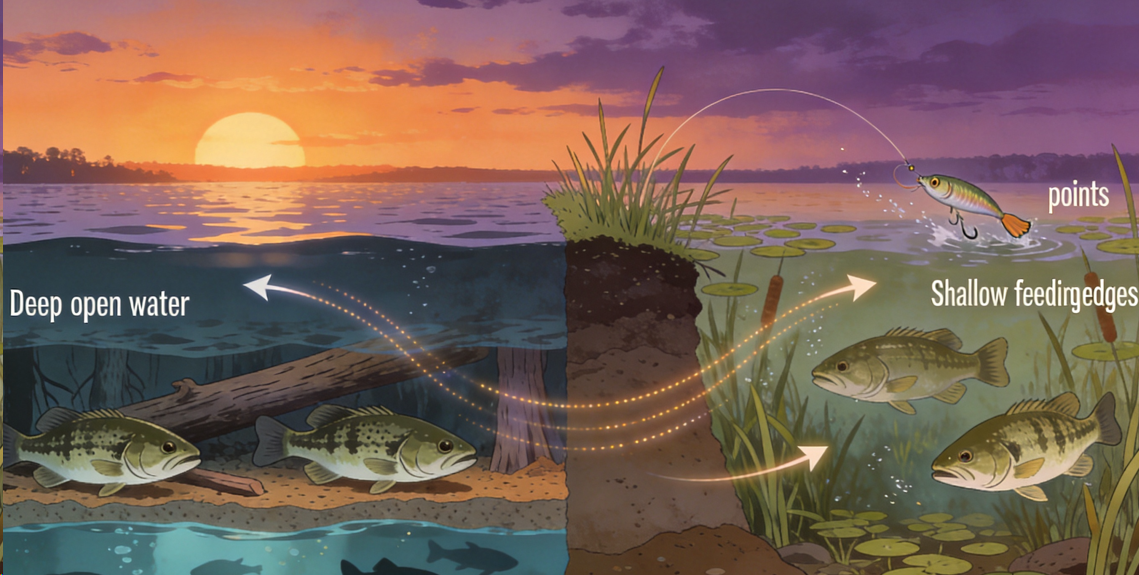
But here’s what happens at night: the surface cools. Not dramatically — maybe three to five degrees — but enough. Combined with the absence of bright sunlight (which makes bass visibility-conscious and cautious), the evening hours create a window where bass will move shallow to feed. They leave their deep-water refuge and move onto points, weed edges, and structure that’s been inaccessible to daytime anglers for months.
This window is narrow. It opens at dusk, peaks during the first two hours of darkness, and closes as the moon rises high enough to make the shallow water feel exposed again. The most productive period — the “night bite” — typically runs from 9:30 PM to 11:30 PM in mid-summer Texas.
What You Need (And What You Don’t)
You don’t need expensive night-fishing gear. You need three things:
1. A Red LED Light
Not white. Red.
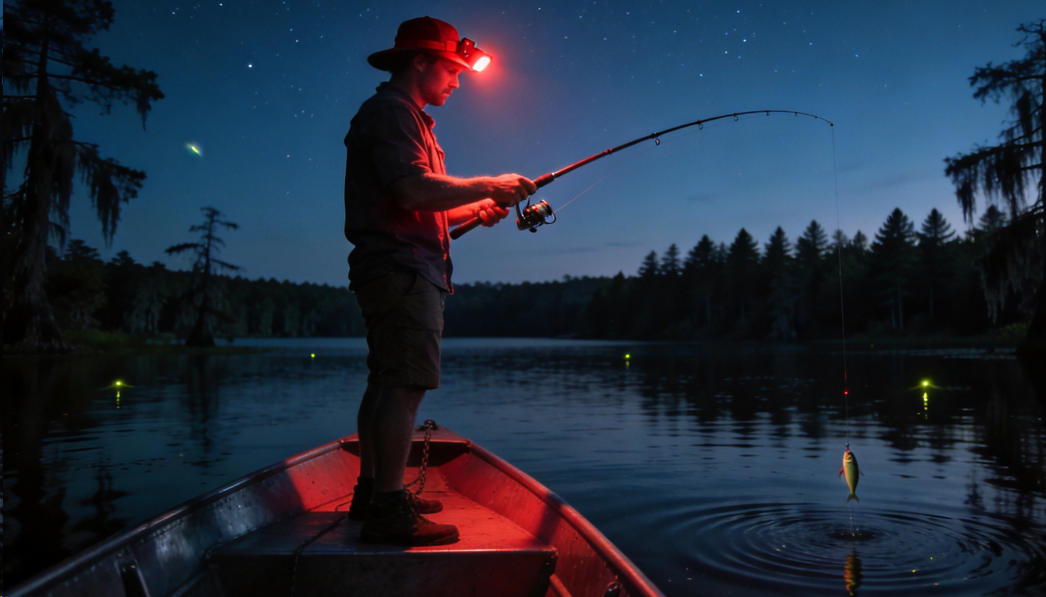
White light spooks fish. It’s too bright, too startling, and it kills your night vision instantly. Red light is different — it’s visible to humans (so you can see your knots, your lure, your hands) but nearly invisible to fish. Bass can’t see red light the way we can. It’s like they’re fishing in a dimly lit room while you’re fishing in daylight.
A small LED clip light that mounts to your hat or rod holder costs twelve dollars at any outdoor store. That’s all you need.
2. A Topwater Lure
This is the single most effective night bass lure. Topwater lures create surface disturbance — a pop, a walk, a twitch — and that vibration travels through the water like a dinner bell in pitch darkness. Bass can’t see you, but they can absolutely hear and feel the commotion. A topwater strike at night is one of the most primal experiences in fishing: your lure explodes on the surface with a sound like a firecracker, your rod bends, and for thirty seconds you’re fighting a fish that you cannot see, guided entirely by sound and pressure in your hands.
Recommended topwater lures for night bass:
Walking bait (Walk-the-Dog style) — creates a side-to-side surface wake that’s visible even in low light
Popper — produces a loud bubble and splash that bass associate with injured baitfish
Frog — for heavy cover where topwater lures normally get snagged; frogs produce a soft “plop” that’s nearly silent but highly attractive to bass hiding in lily pads
3. Patience and a Headlamp (with red mode)
Your headlamp should have a red light setting. If it doesn’t, buy a cheap one that does — or use the red LED I mentioned above. White light ruins your night vision for ten to fifteen minutes after you look at it. Red light preserves it.
The Night Fishing Framework
Daytime bass fishing is about reading water, finding structure, and presenting lures with precision. Night bass fishing is about the same things, but the variables shift. Here’s how to adapt:
Locate Shallow Water Accessible from Deep
This is the golden rule of night bass fishing. Bass move shallow at night, but they don’t move far. They leave their deep-water holdover points and travel along the connecting channels — the submerged points, the drop-offs, the old river channels — to reach shallow feeding areas.
Your strategy: find a deep area (twelve to twenty feet) that connects to shallow water (two to six feet) via a visible underwater point or ledge. Cast your topwater lure along that transition zone. The bass will be lying in wait at the edge of the shallow water, watching for prey that ventures too close.
Cast Into Cover, Not Open Water
During the day, bass hold near structure but often face away from it, positioned to ambush passing prey. At night, they move into structure — onto weed beds, under lily pads, around submerged timber. Your topwater lure needs to land in or near cover, not in the open water between cover patches.
A walking bait worked along the edge of a weed line is lethal at night. A popper twitched in an opening within a lily pad field is even better. The key is proximity to cover — bass don’t feed in open water at night. They feed at the edges.
Slow Down Everything
This cannot be emphasized enough. Daytime topwater retrieves can be quick and aggressive — fast walks, sharp pops, rapid twitches. Night retrieves should be slow and deliberate.
Bass are less aggressive in cool water, and nighttime conditions reduce their metabolic rate compared to midday. A slow, methodical presentation gives them time to track, approach, and commit to your lure. Rush it, and you’ll miss half the strikes.
Standard night topwater retrieve: walk the bait two feet, pause for two seconds, walk another two feet, pause again. Repeat until the lure disappears into the weeds or — more excitingly — explodes.
The Texas-Specific Night Pattern
Texas summer night bass fishing has a rhythm that repeats almost nightly once you learn to read it. Here’s what the evening looks like, hour by hour:
7:30 PM — Dusk begins. The sky transitions from blue to purple to deep gray. Bass haven’t moved yet. They’re still holding at the thermocline, waiting for the light to fade below the threshold that triggers their feeding response. This is the worst time to fish. Everyone is casting, everyone is frustrated, and nothing is happening.
8:30 PM — First movement. You’ll see it if you’re paying attention — ripples on previously glassy weed edges, the occasional splash as a bass follows a topwater lure but doesn’t commit. This is the warmup. Don’t expect bites yet. Use this time to position your boat, set up your lights, and start working the edges.
9:30 PM — The bite opens. This is the window. Bass move fully onto shallow structure, and the topwater strikes begin. They’re not constant — there are lulls of three to five minutes between strikes — but they’re frequent enough that if you’re working the right pattern, you’ll hook up at least once every ten to fifteen minutes.
11:00 PM — The bite closes. The moon rises higher. The shallow water feels exposed again. Bass retreat toward deeper cover, and the strikes slow to a trickle. This is your cue to either move to a different location with more overhead cover (tree canopies, dock overhangs) or pack up and come back tomorrow.
Safety and Practical Considerations
Night fishing introduces risks that daytime anglers rarely consider. Here’s what you need to know:
Hypothermia Is Real in Summer
This sounds contradictory, but it’s true. Texas summer nights are humid and warm during the day, but once the sun drops, temperatures can fall fifteen to twenty degrees within an hour. Combined with wind chill from being on open water and the occasional spray from casting, you can get chilled even in August.
Bring a light jacket. Keep it in a dry bag. Put it on during the lulls between strikes. One case of the shivers mid-cast is enough to ruin your night.
Insects Are Worse at Night
Mosquitoes, no-see-ums, and horse flies all prefer dusk and nighttime feeding. They’re not dangerous in Texas, but they’re relentless and they’ll make any outdoor experience miserable if you’re not prepared.
DEET or picaridin repellent. Long sleeves if you can tolerate them. A hat with a wide brim keeps most bugs off your face. Do not skip this.
Boat Safety
If you’re fishing from a boat at night, your PFD (personal flotation device) is non-negotiable. Night-time drowning is a real risk, and it’s almost always preventable.
Also: know your surroundings. If you’re casting near docks, pilings, or shallow structure, be aware that you can’t see obstacles in the water. Slow your boat speed to idle when repositioning. Use your red light to scan the area ahead before moving.
Why This Changes Everything
The same bass that are invisible at 2:00 PM in the shade of a boat dock are actively feeding at 10:00 PM on a shallow point half a mile away. Same fish. Different schedule.
Night fishing opens an entire season that most anglers quietly abandon. And here’s the bonus: it’s quieter. Fewer boats on the water. Fewer anglers competing for the same structure. The lake feels different at night — not just darker, but more intimate. You hear the water slap against the hull. You hear your lure pop and walk. You hear the strike before you see it.
It’s a completely different sport from daytime bass fishing, and that’s why it works so well in Texas summer.
Your First Night Out
If you’ve never fished for bass at night, here’s your checklist:
Check local regulations. Some Texas lakes have night fishing restrictions. Some don’t. Know before you go.
Go with someone. Even if they’re not fishing — just have someone in the boat with you. Safety first.
Arrive at dusk, not midnight. You need forty-five minutes of twilight to position yourself, set up lights, and start working the edges before the prime bite window opens.
Bring one topwater lure and learn it. Don’t bring five. Bring one walking bait or popper, practice your retrieve in the dark, and commit to it. Mastery beats variety every time.
Expect zero bites for the first hour. This is normal. The fish are still finding their rhythm. Stay calm. Stay patient. The bite will come.
Many first-time night anglers go home convinced they’d missed something — that the real fishing happens during the day and they’d wasted three hours in the dark. They’re wrong. They’d just haven’t been fishing long enough to reach the bite window.
Give it ninety minutes. Then give it another thirty.
The Texas heat doesn’t kill summer fishing. It just changes the schedule. Learn the new one, and you’ll have the lake to yourself.